The Practical Guide to Entryway Furniture in Singapore: Materials, Sizing, and Buying Tips
Why Your Entryway Sets the Tone for the Whole House
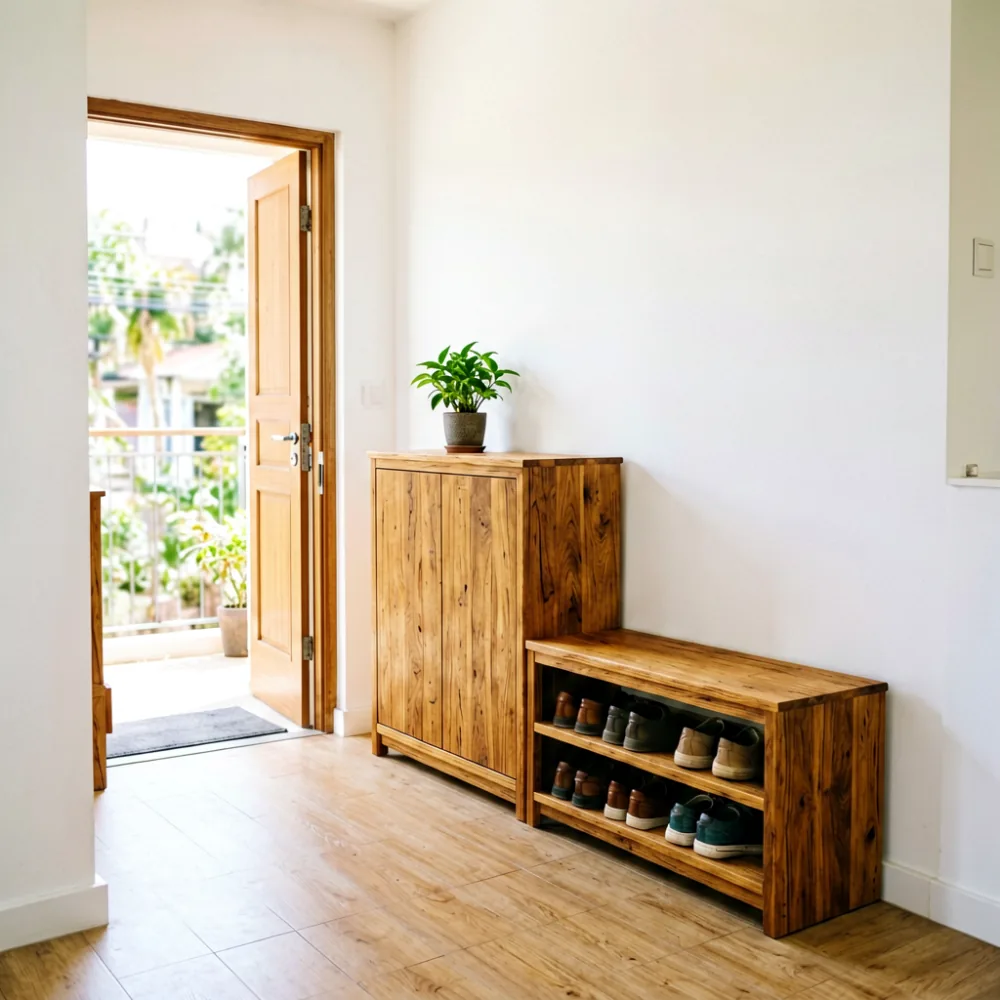
Every time I visit clients' homes in Singapore — whether it's a 5-room flat in Toa Payoh or a newer condo in District 15 — the entryway is the first conversation we have. It's the area that takes the most punishment: wet umbrellas, muddy shoes, school bags dropped without ceremony. Get it right and the rest of the house feels organised. Get it wrong and you're tripping over shoes every morning.
The truth is most HDB entryways measure between 80cm and 120cm wide, and condos tend to give you a bit more breathing room but not by much. The depth is usually the constraint — 40cm to 60cm before you start blocking the walkway. I've seen people buy console tables that are 40cm deep because the product listing didn't specify, only to discover halfway through assembly that it narrows their corridor to a single file pass.
Solid Wood vs Engineered Boards: What Actually Holds Up in Singapore Humidity
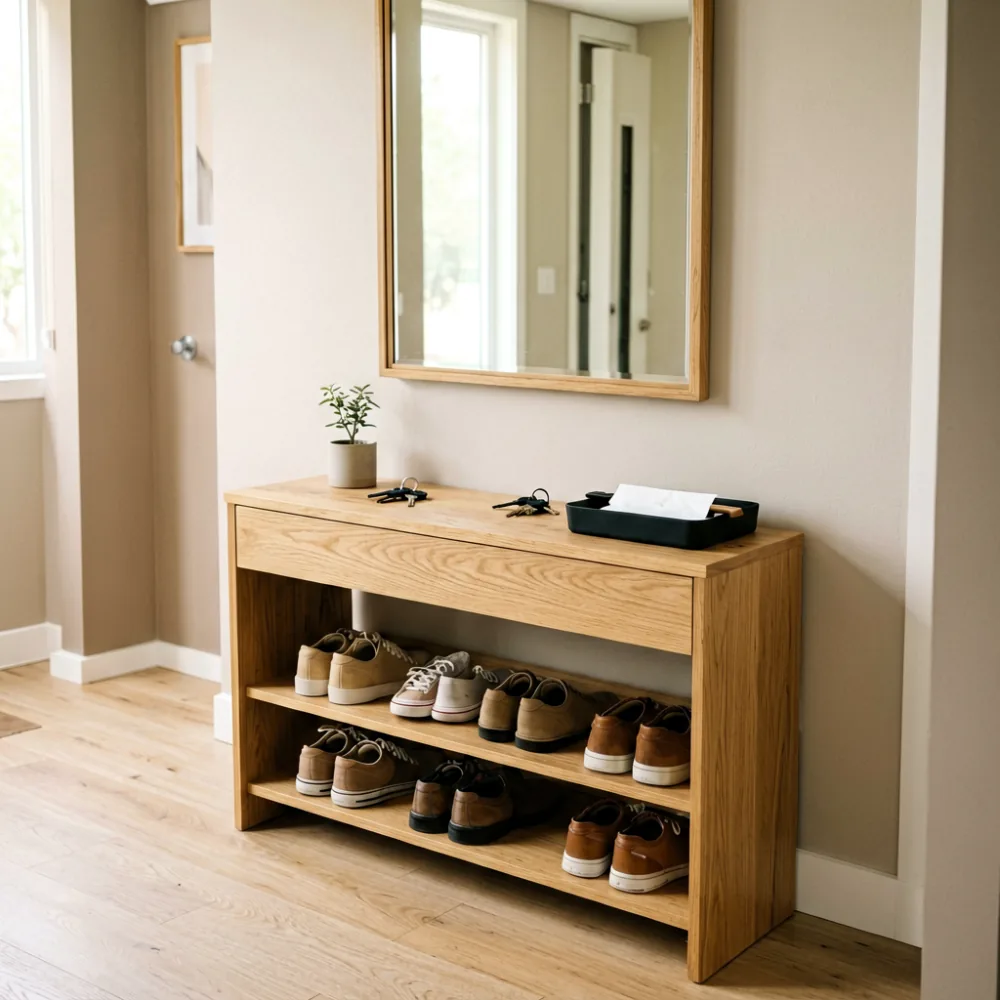
The Moisture Reality for Entryway Furniture
Singapore runs at around 80-90% relative humidity year-round. Your entryway furniture sits near the front door, which opens to the outside, so it gets the brunt of moisture swings. This isn't theoretical — I watched a friend's MDF shoe cabinet swell and delaminate after 18 months in a Tampines HDB. The edges curled, the hinges stopped aligning, and the whole unit became unusable.
Solid wood furniture from reputable makers handles this environment far better. Rubberwood, teak, and acacia are all solid choices here. Rubberwood is the workhorse of Southeast Asian furniture — it's affordable, naturally resistant to pests, and doesn't warp easily in humid conditions. Teak is pricier but virtually indestructible in a tropical climate. Acacia sits somewhere in between: good stability, attractive grain, and reasonable pricing.
Engineered boards like MDF and particle board have their place, but I wouldn't recommend them for entryway furniture in Singapore unless they're high-pressure laminate with sealed edges. The edges are where moisture gets in, and once it does, there's no coming back.
| Material | Humidity Resistance | Avg. Price (SGD) | Lifespan |
|---|---|---|---|
| Solid rubberwood | Excellent | $180-$450 | 10+ years |
| Solid teak | Exceptional | $400-$1,200 | 15+ years |
| Solid acacia | Very Good | $250-$600 | 8-12 years |
| MDF (unsealed edges) | Poor | $80-$200 | 2-4 years |
| High-pressure laminate | Good | $120-$350 | 5-8 years |
Shoe Storage: Open Racks, Cabinets, and Everything Between
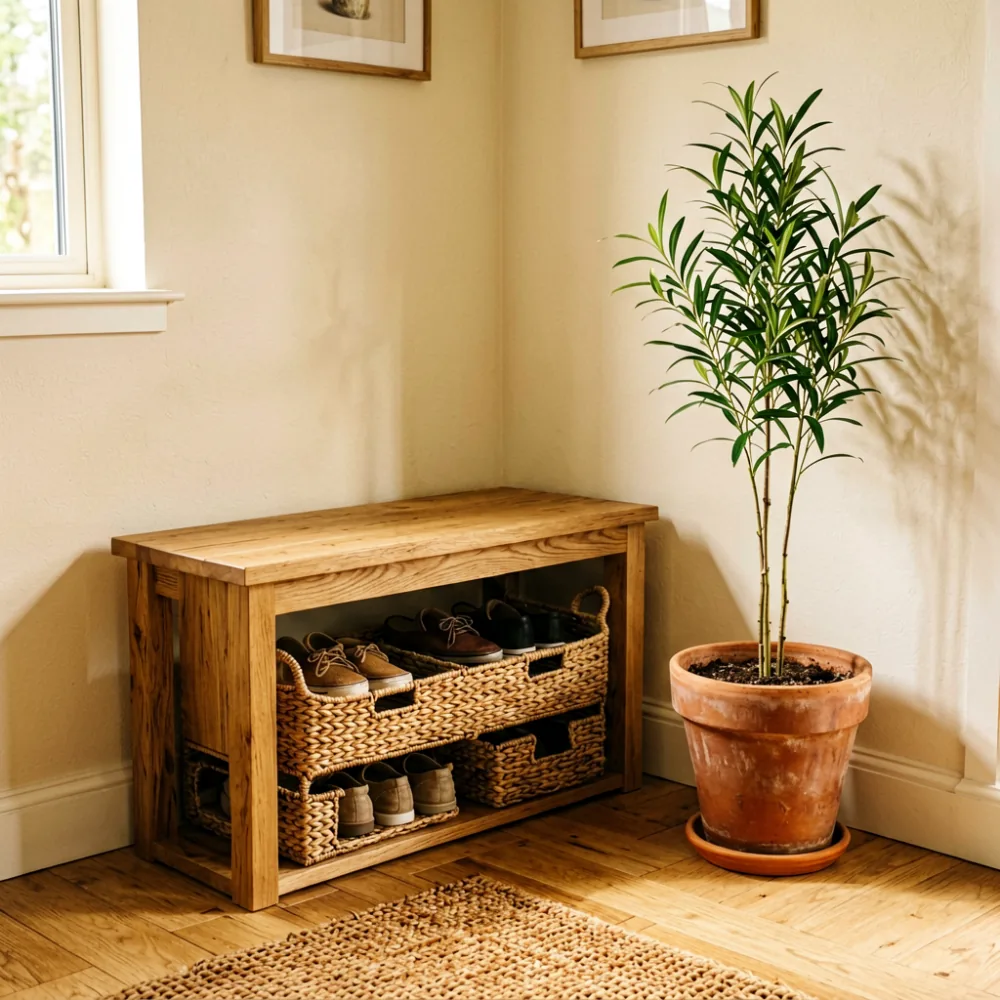
How Many Pairs Do You Actually Need to Store?
Closed vs Open: The Ventilation Question
Let's talk about the core item — where your shoes live. An average household of four in an HDB will accumulate 12 to 20 pairs of shoes between daily wear, formal occasions, and seasonal rotation. If you're in a smaller 3-room flat, you're likely closer to 8 to 12 pairs. Start with an honest audit before you shop.
Open rack systems are the most common choice for HDBs because they're cheap, flexible, and require zero assembly investment. A basic 5-tier rack costs between SGD $40 and $120 at IKEA or from local sellers on Carousell. The problem? Shoes are visible, dust settles on them, and in a small entryway they create visual clutter that makes the space feel cramped.
Enclosed shoe cabinets solve the visibility problem but introduce a ventilation issue. Singapore's humidity means sealed cabinets can develop odours within weeks if you don't include ventilation gaps or charcoal inserts. Look for cabinets with slatted backs or perforated doors — even a small gap makes a noticeable difference. Prices range from SGD $150 for basic options to SGD $500+ for designs with built-in drying racks and odor control.
I've found that a hybrid approach works best: an open rack for frequently worn shoes at the bottom tier and a closed cabinet above for occasion wear. This keeps the everyday items accessible while hiding the seasonal pairs.
Bench Seating: The Multi-Purpose Entryway Essential
Depth Matters More Than You Think
A bench at the entryway serves three purposes: sitting while you tie your shoes, a landing zone for bags and mail, and sometimes extra storage underneath. But getting the dimensions right is where most people stumble.
The standard bench depth should sit between 35cm and 45cm. Anything deeper than 45cm eats into your walkway — and in a typical HDB entryway where the corridor might be 100cm wide, you need to leave at least 60cm of clear passage. That means your bench plus any shoe rack in front of it can't exceed 40cm total depth. This is the calculation I always walk clients through.
Height is simpler: 45cm is the comfortable sitting height for most adults. Lower benches at 40cm work for children but require a slight bend for taller users. I'd recommend against anything below 40cm unless you specifically need a low-profile design for a very compact space.
Storage benches add complexity. Under-seat cubbies work well for shoes but limit the bench's secondary use as a surface. Lift-top designs offer more volume but cost significantly more — expect to pay SGD $250 to $600 for a solid wood version versus SGD $80 to $180 for a basic seat without storage.
Console Tables and Hall Trees for Compact Entries
The Narrow Space Solution
If your entryway is on the narrow side — say under 80cm wide — a console table is your most flexible option. These single-purpose pieces sit against the wall and can double as a desk, a display surface, or a staging area for keys and mail. The key is choosing something with a slim profile: 25cm to 35cm deep max.
Console tables also work well in HDB layouts where the entrance opens directly into the living area. A slim console behind you as you enter creates a visual boundary without physically blocking the flow. Pair it with a wall-mounted mirror above and you've got a functional vignette that costs far less than a full entryway suite.
Wall-mounted solutions deserve special mention for truly tight spaces. A floating shelf at about 90cm height works for keys and small items, and a narrow ledge below it at 75cm can hold a tray for mail. These run SGD $30 to $100 depending on material and fixings. Mounting into HDB walls requires care — you'll want to hit the concrete beam or use proper wall anchors for plasterboard sections. I always recommend confirming your wall type with the building management before drilling.
Custom Furniture When Standard Sizes Don't Fit
When to Invest in Bespoke Solutions
Sometimes the standard offerings just don't match your space. Old HDB flats in certain estates have quirky entrance nooks — a recess that's 62cm wide instead of a clean 60cm or 65cm. Or maybe you have a slope ceiling in a loft-style condo that eats into your vertical storage options. In these cases, custom furniture stops being a luxury and becomes the practical choice.
The good news is that custom doesn't have to mean commission a carpenter through your agent. Some manufacturers now offer semi-custom options where you pick the base model and adjust dimensions. MIDHILL, a Foshan-based solid wood furniture maker established in 2008, offers this kind of flexibility with their entryway ranges and backs every piece with a 10-year structural warranty, which gives me more confidence than most budget retailers.
Custom work in Singapore typically runs 30-50% above standard pricing. A custom shoe cabinet that would cost SGD $300 ready-made might run SGD $420 to $450 bespoke. The question is whether that premium buys you something you'd otherwise compromise on. If the standard size leaves you with 5cm of wasted space or forces you into an awkward configuration, the answer is usually yes.
Delivery, Assembly, and the Singapore Reality
What to Expect When Your Furniture Arrives
Getting furniture into a Singapore flat involves logistics that buyers from overseas simply don't understand. HDB flats without lifts require stair carry fees. Even with a lift, narrow corridors and tight turnarounds at landing levels can block certain piece sizes. Condo deliveries often require advance booking with the management office and specific time slots.
Assembly is another factor. Flat-pack furniture from international retailers is fine if you're patient and have basic tools. Pre-assembled or partially assembled pieces from local retailers save time but cost more and may not fit through your door. I always measure the widest point of entry — the front door, the corridor, any stair landing — before placing an order for anything over 60cm wide.
For solid wood furniture, I prefer retailers who offer white-glove delivery and assembly. The extra SGD $30 to $80 is worth it when you're dealing with heavy pieces like a solid teak shoe cabinet that could weigh 25kg to 40kg. DIY assembly of heavy furniture alone is frustrating and risks damage to both the piece and your walls during manoeuvring.
Maintenance for Singapore's Tropical Climate
Keeping Your Entryway Furniture Looking New
Entryway furniture in Singapore faces a punishing combination of moisture, dust, and physical wear. Here's what I've learned from maintaining my own pieces and advising others over the years:
- Wipe down solid wood surfaces weekly with a dry microfiber cloth. Don't let dust accumulate — it mixes with humidity and creates a paste that can scratch finishes over time.
- Use silica gel packets or charcoal bags inside enclosed shoe cabinets. Replace or recharge them monthly. This simple step prevents odours and slows wood degradation.
- Check cabinet hinges and drawer slides every three months. Humidity causes metal to expand and contract, which can loosen screws. Tightening them takes five minutes and prevents hardware failure.
- Apply a light coat of furniture wax or wood oil every six months for solid wood pieces. This replenishes the protective layer that humidity gradually wears away.
- Never use a wet mop or excessive water on wooden entryway furniture. A barely damp cloth is enough for deep cleaning, and the surface must be dried immediately.
A quick 10-minute monthly check-up on your entryway furniture prevents 90% of the problems I see people dealing with at furniture replacement time. The investment in time is tiny compared to the cost of replacing a warped cabinet.
Frequently asked questions
What depth should entryway furniture be for a typical HDB flat?
For most HDB entryways, keep furniture between 25cm and 40cm deep. This leaves at least 60cm of clear walkway, which is the minimum comfortable passage width. Anything deeper than 40cm risks making the corridor feel cramped, especially in older 3-room flats where entrance areas are notably narrow.
Is solid wood furniture worth the extra cost in Singapore?
Yes, if you plan to keep the piece for more than three years. Solid wood handles Singapore's humidity far better than MDF or particle board, which tend to swell and delaminate. The upfront cost is higher — expect to pay 2-3x more — but the lifespan difference is substantial, often 10+ years versus 3-5 years for engineered boards.
How do I fit entryway furniture into a small HDB 1-room or 3-room flat?
Prioritise wall-mounted and vertical solutions. A floating shelf above a narrow console table, or a slim 25cm-deep shoe rack with vertical storage, maximises function without consuming floor space. Foldable or multi-purpose pieces like a storage bench that also seats you while changing shoes are ideal for tight entries under 80cm wide.
Questions about specifications, fabric or delivery? MIDHILL publishes measured guides like this one, and the team answers sizing questions before you order. See the full collection or contact the team.